What is seinen?
Seinen (said SAY-nen) is the Japanese publishing label for manga, and the anime adapted from it, first printed in magazines for adult men.
- The word means young man.
- It names a readership, not a genre.
- Typical readers are adult men, roughly 18 to 40.
- Stories tend toward adult work, consequences and moral gray areas.
Ask Anselm about the work
Seinen vs shonen vs shojo vs josei
Most Japanese manga is sorted into four big readerships, named for the people each magazine was first printed for. Shonen and shojo magazines are aimed at boys and girls. Seinen and josei magazines are aimed at grown men and grown women. Anime inherits the label of the manga it adapts, so a seinen anime is usually one whose source ran in a seinen magazine.
The table below lines the four up. Read it as tendencies, not rules: every one of these categories holds comedies, thrillers, romances, sports stories and quiet ones.
| Feature | Shonen | Shojo | Seinen | Josei |
|---|---|---|---|---|
| Said | SHOH-nen | SHOH-joh | SAY-nen | JOH-say |
| Literal meaning | boy | girl | young man | woman |
| First printed for | boys | girls | adult men | adult women |
| Typical focus | Action, rivals, training, friendship | Feelings, relationships, inner life | Work, consequences, moral gray areas | Everyday adult life, careers, relationships |
| Typical tone | High energy and hopeful | Emotional and expressive | Measured, often darker | Grounded and realistic |
| Art tendencies | Bold motion lines, big action panels | Decorative, flowing pages, expressive faces | Detailed, realistic proportions | Clean, understated, realistic |

What does seinen mean, word by word?
Seinen is written 青年 in Japanese. The first character carries the sense of green or fresh, and the second means year, so together they mean youth or young man. In everyday Japanese the word simply describes a young adult. In publishing it became the name of a market.
Say it in two even beats, SAY-nen. The ei is the same sound as in say, and the second syllable is short. You will see it written seinen manga or seinen anime, and in English it is used as both a noun (a seinen) and an adjective (a seinen series).

What makes a story feel seinen?
Because the readers are adults, seinen editors can assume patience, life experience and a tolerance for ambiguity. That shows up as a set of habits rather than a formula. A well made seinen story usually has several of these:
- Adults with jobs and histories. The hero has rent, a boss, a past and a reason to be tired.
- Consequences that stick. A wrong call costs something, and the story does not hand it back by the next chapter.
- Moral gray. Antagonists have reasons, heroes have blind spots, and the ending may not say who was right.
- A slower, quieter pace. Scenes are allowed to breathe, and a whole chapter can turn on one conversation.
- Detailed, grounded art. Proportions lean realistic and backgrounds are drawn with care.
Seinen is a readership, not a genre
This is the most common mix-up. People say seinen when they mean dark, violent or mature, but the label only tells you which magazine a story first ran in. A seinen magazine might print a brutal war story next to a gentle cooking comedy and a story about a retired couple learning to garden. All three are seinen.
The reverse is true too. Plenty of stories printed for boys get very dark, and plenty of adults read shonen every week. The demographic is a starting point for a reader, a guess about who will enjoy a story, never a rating or a ruling on its content.
So the honest answer to whether a story is seinen or shonen is usually: check where it was first serialized. Everything else is a vibe, and vibes overlap.
How to write a seinen-style character
Start with the job. A seinen character is shaped by what they do all day: a night-shift paramedic, a structural engineer who signed off on a bridge, a salvage pilot who walks thirty-ton machines through a hull breach. The work gives them competence, scars and a reason to keep going.
Then give the past weight. One decision they would make differently. One person they still owe. Let it shape how they talk now, not just appear in a flashback.
Finally, let them be tired and keep going anyway. The emotional core of a lot of seinen is not winning. It is showing up again the morning after you lost.
Talking to a grown-up character on oeYYeo
No oeYYeo character comes from a magazine, but Anselm Kovacic carries the tone seinen is known for. He is 25, lead test pilot for heavy salvage frames at an orbital shipyard, and he reads the preflight checklist out loud because he has seen what skipping a line costs. He talks in clipped radio rhythm and drops one honest sentence when it counts.
Ask him about the work and he answers like someone who does it for a living. Every character on oeYYeo is AI, and the app says so under the box where you type. Chat is for adults 18 and over, and chatting with the whole cast is free.
In their own words
Bad shift. Frame's fine. Rookie's fine. I signed the report. That's the job. Now we eat.
Fear doesn't go away. You just learn which part of it is information.
Meet Anselm
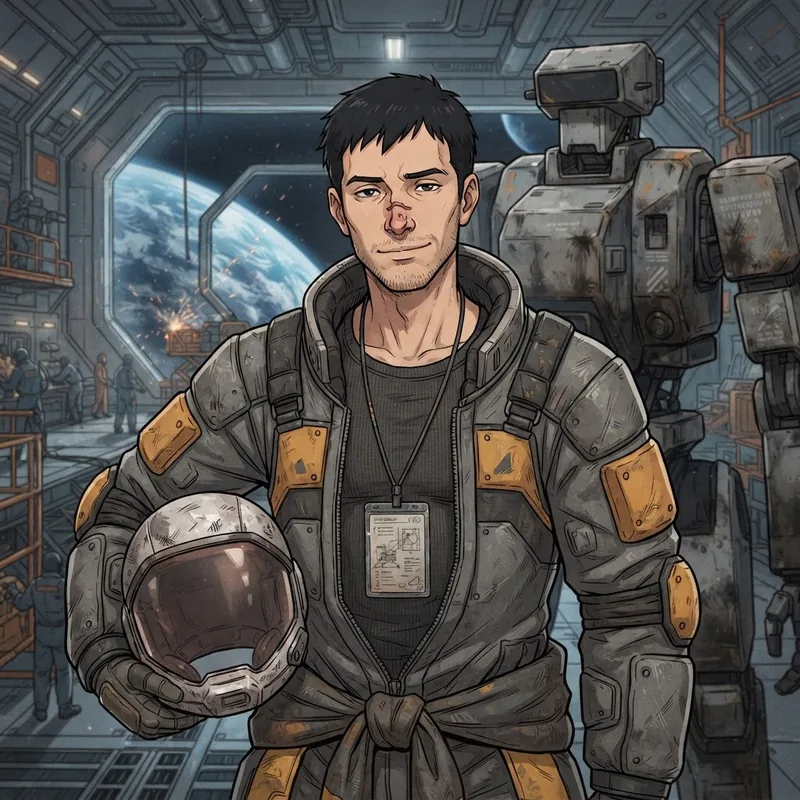
Mecha: the test pilot
Anselm Kovacic, 25
Rookie two years ago, lead test pilot now. He still reads the preflight checklist out loud.
Common questions
What is the difference between seinen and shonen?
Shonen manga is first printed in magazines for boys, seinen in magazines for adult men. Seinen tends toward slower pacing, adult jobs and moral gray areas, shonen toward action, rivals and growth, but both labels describe the readership, not the content.
Is seinen the same as mature or dark?
No. Seinen magazines print gentle comedies, cooking stories and slice of life alongside thrillers. The label says who the magazine was for, not how dark a story gets.
How do you pronounce seinen?
SAY-nen, two even beats, with the ei sounding like the English word say.
What is the female version of seinen?
Josei, the label for manga first printed in magazines for adult women. Shonen and shojo are the boys' and girls' counterparts.
How can I tell if an anime is seinen?
Look up the magazine its source manga first ran in. Anime takes the label of its source, so an original anime with no manga behind it often has no demographic at all.
Read next
Honest by design.
Every character on oeYYeo is AI, and the app says so where you type. Chat is for adults 18 and over.