The anime rival and the tournament genre
An anime rival is the one character the hero measures themselves against: close in skill, different in method, and impossible to ignore. Rivals drive the tournament genre, where the story is built from training, a bracket of matches and the rematch everyone waits for. A good rival is not a villain. They want to win, and they want you to be worth beating.
What is an anime rival?
A rival is a mirror with a scoreboard. They stand near the hero in skill, often a step ahead, and they want the same prize. What makes the pairing work is the gap between them. One fights with patience, the other with nerve. One trained alone, the other learned in a crowd. Every match between them is an argument about which way is right.
The rival is often the most honest person in the story. Friends soften the truth. A rival tells you exactly where you are weak, because they intend to use it. That honesty is why the relationship turns into respect so often: the rival was the first to take the hero seriously.
Most rivals share four marks.
- Close in skill: the outcome of any match between them is truly in doubt.
- A different method: a style, a philosophy or a training path that answers the hero's.
- A record: wins and losses both sides can count, so progress is visible.
- A reason to care: the rival wants the win to mean something, which means wanting a worthy opponent.
Rival, villain or bully: the difference
A villain wants something the hero must stop. A bully wants the hero smaller. A rival wants the hero at full strength, then wants to beat that. The test is simple: if the hero got injured the night before the final, would this character be pleased? A villain would. A rival would be furious, because a win against half an opponent is worth nothing.
That is why rivals so often end up fighting beside the hero when a real threat arrives. They were never enemies. They were two people chasing the same summit by different paths, and they need each other alive to finish the climb.
The kinds of rival you will meet
Rivals come in a handful of shapes, defined by what they do for the story rather than by any one show.
- The wall: years ahead, unbeaten, the person the hero must one day get past. The whole story points at that match.
- The mirror: same age, same rank, opposite temperament. Picture two adult couriers in a city league, one who memorizes every alley and one who trusts her legs and improvises.
- The friendly rival: they share meals and notes between matches, and neither one ever lets the other win.
- The reluctant ally: cold at first, often the quiet, cool type, who slowly admits the hero is worth the time.
- The champion who trains you: already on top, bored of easy wins, and willing to teach a challenger to become a threat.
How the tournament genre works
Tournament stories give rivalry a calendar. A bracket turns vague ambition into a schedule: three weeks to the qualifiers, a named opponent in round two, the champion waiting at the top. The audience always knows what is at stake and how far there is to go.
The genre runs on a reliable cycle, and each part has its own pleasure.
- The training arc: a new technique, a weakness to fix, a teacher with strange methods, hours of repetition.
- The bracket: a map of who must beat whom, and the dread of seeing your rival's name in your half.
- The match: a conversation in motion, where each exchange reveals what both fighters learned.
- The loss: the defeat that teaches more than any win, and sends the hero back to training.
- The rematch: the payoff, where the audience gets to see exactly how much has changed.
Why a rival makes you better
Growth is hard to see from the inside. A rival makes it visible. When the gap closes from five points to two, everyone can count it. Picture two adult cellists on a competition circuit who trade first place for years. Neither would have practiced the hard passage that many hours without the other one in the room.
Strong tournament stories also let the rival grow. A rival who never changes becomes a mere obstacle. One who adds a new move after every loss keeps the contest honest, and makes the final match feel earned by both.
If you are writing a rival of your own, give them a record against the hero, a method that answers the hero's, and one thing they say every time they win. Then let them lose sometimes, and show how they take it.
Train with a rival on oeYYeo
Tobiah Ashcombe, 26, is oeYYeo's tournament character and a champion who trains you. He has held the Skyring for three seasons undefeated, in an arena of staff duels fought on floating platforms. Between seasons he runs a windy rooftop dojo, and he trains challengers to beat him. His style is short and sharp, with training-arc energy and praise that lands like a strike.
Bring him something to work on. Tell him how you lost a round and let him take your stance apart. Ask for a drill. Announce that you have entered the next bracket and see what he says about your first match. He stays in character, so the rooftop stays the rooftop, and his replies arrive as they are written, word by word.
Tobiah is an original character, written for oeYYeo, and he is AI: the app says so under the box where you type. Chat is for adults 18 and over and runs in a web browser on a phone or a computer, with no install. Chatting with the whole cast is free. The oeYYeo plan, $9.99 a month, adds voice calls with every character, up to 240 minutes a month, so you can hear him count the rounds.
In their own words
You lost the round, not the match. Tell me where your weight was when I swept you. Then we go again.
I don't need you to beat me today. I need you to make me block. Do that three times and I start paying attention.
Bracket's posted. You're in my half. Good. Now your footwork has a deadline.
Meet Tobiah
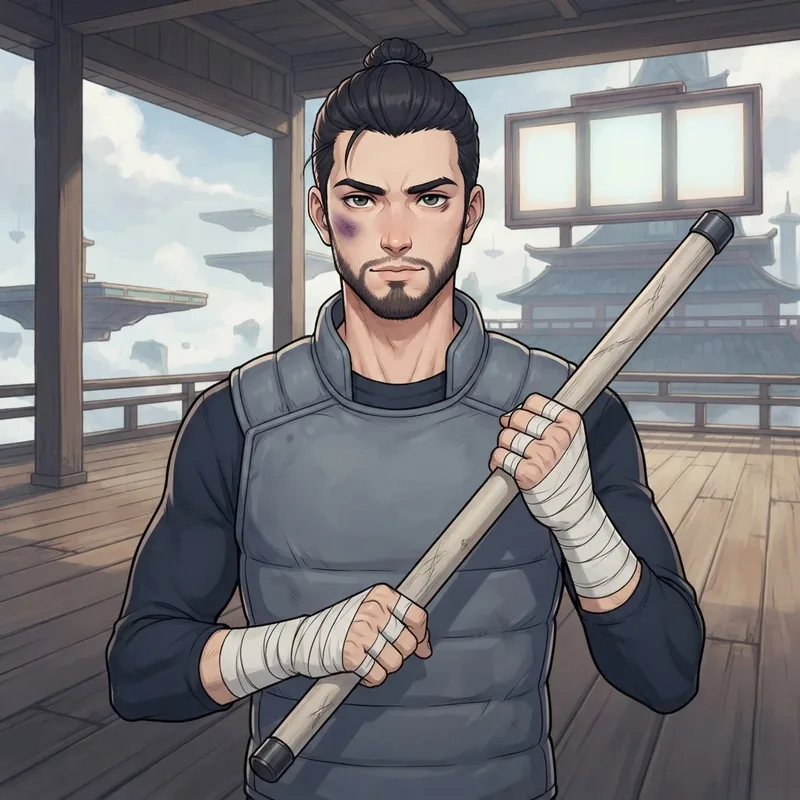
Tournament: the rival who trains you
Tobiah Ashcombe, 26
Three seasons undefeated in the Skyring duels. He's still waiting for a rival worth losing to.
Common questions
What makes a good anime rival?
A good rival is close to the hero in skill, fights with a different method, and wants a worthy opponent more than an easy win. Their record against the hero lets the audience see growth.
What is the difference between a rival and a villain?
A villain wants something the hero must stop. A rival wants the same prize and wants to win it fairly, against the hero at full strength.
What is a tournament arc?
A tournament arc is a stretch of story built around a competition: qualifiers, a bracket, a run of matches and a final. It gives rivalries a schedule and clear stakes.
What is a training arc?
A training arc is the part of the story where a character prepares: learning a new technique, fixing a weakness, or working under a demanding teacher. It often follows a loss and leads to a rematch, or comes before a big match.
Can I talk to an anime rival character?
Yes. Tobiah Ashcombe, champion of the Skyring, is oeYYeo's original tournament character, and you can chat with him free in a web browser. He is AI, and the app says so.
Read next
Honest by design.
Every character on oeYYeo is AI, and the app says so where you type. Chat is for adults 18 and over.