Slice of life anime, explained
Slice of life anime is the genre of ordinary days. Instead of a quest or a villain, it follows people through work, meals, weather and small talk, and lets the mood carry the story. Nothing big has to be at stake. The pleasure is in noticing things: the rain starting, the regular who always takes the window seat, a tired friend who finally laughs.
What makes a story slice of life?
Most stories are built like a staircase. Something goes wrong, the stakes climb, and the ending pays it off. Slice of life is built like a window. You look in on a few people at a time in their lives, watch for a while, and look away. The story does not need to go anywhere for the visit to be worth it.
That shift changes everything downstream. The basic unit is the scene, not the arc. Time is measured in seasons, shifts and meals rather than countdowns. Conflict is personal and small: a burnt batch of bread, a friend who moved away, a choice about whether to stay in a city. And the setting stops being a backdrop. A good slice of life place, a cafe, a repair shop, a night ferry, is half the cast.
- Scenes over plot: each moment is meant to stand on its own.
- Small stakes: the question is how a day feels, not whether the world survives.
- Routine as structure: opening up, the usual order, the last train home.
- Place as character: weather, light and sound do real storytelling work.
Why a quiet story still holds you
People new to the genre often expect it to be dull, and are surprised by how hard it is to stop. The trick is that tension has not gone away. It has shrunk to a human size. Will he say the thing he has been holding back? Will the cake run out before she gets a slice? Small questions land because you have spent time with the people asking them.
Slice of life also trades escalation for release. A thriller tightens you up and lets go at the end. A quiet story lets go the whole way through. That is why so many viewers keep one running after a long day, and why the gentlest corner of the genre is often called healing, or iyashikei: stories whose main job is to leave you calmer than they found you.
Because there is no long plot to keep straight, you can also arrive anywhere. Skip a week and nothing is lost. The world was still there, having its ordinary days without you.
The kinds of slice of life you will find
Slice of life is less a single genre than a way of telling a story, so it attaches to almost any setting. These are the common shapes, described in our own words rather than by pointing at any particular show.
- Workplace: a bakery, a bookshop, a ferry crew. Regulars, rush hours and the quiet after close.
- Food: cooking, eating and sharing a table, where a recipe can carry a whole memory.
- Hobby and craft: a pottery wheel, a band, a garden plot. Getting slowly better at something.
- Rural and travel: someone moves somewhere smaller, or keeps moving, and learns its rhythms.
- Healing (iyashikei): almost no conflict at all, just light, weather and kindness.
- Shared house: roommates or neighbors, and the comedy of living close together.
- Ordinary magic: one strange element, a ghost or a talking cat, treated as everyday.
Slice of life suits grown-ups
The form works especially well with adults, because adult life is full of the texture the genre lives on: rent, regulars, a job you are good at and tired of, friends you have to make time for, the particular loneliness of a big city at night.
Picture a few invented examples. A woman in her thirties who repairs old typewriters and keeps a list of every letter a customer types to test one. Two night-bus drivers who swap one story at every shift change. A retired chef who cooks a single dish a day for whoever knocks. None of them needs a villain. Each one already has a season's worth of scenes.
That is the brief every oeYYeo character is written to. The cast are adults with adult work, and the slice of life member of the cast runs a business, pays for her flour and plays music for the people who stay late.
Meet Mireya Castellan and The Awning
Mireya Castellan, 24, runs The Awning, a tiny cafe on the roof of an old city building. It is open from the first rain to the last train. There are potted plants, fairy lights, mismatched chairs, rain on the canvas overhead and the city lit up below. After 10 PM the cello comes out, and she plays for whoever is still there.
She talks the way the genre moves: soft, seasonal, full of small details, and there is always a cup of something involved. She notices weather, steam, the song you are humming without meaning to. Ask her about her day and you get the price of lemons and the pigeon that has opinions about the third chair. That is not filler. In slice of life, that is the story.
Mireya is an original character written for oeYYeo, and like every character here, she is AI. The app says so under the box where you type.
How to play a slice of life scene in chat
Talking to a slice of life character is different from running a quest. There is no objective to clear, so good conversations start small and stay curious. A few habits help.
- Arrive with a small thing, not a plot: you got caught in the rain, you burned dinner, you cannot sleep.
- Give one sensory detail. Wet shoes, a cold stairwell, the smell of coffee from the landing.
- Ask about her world, not just yours. The cafe, the regulars, what is on the chalkboard tonight.
- Let quiet be fine. A short reply, a sip, a look at the city, is a full turn in this genre.
- Let the scene end. Saying goodnight and returning another evening suits slice of life perfectly.
In their own words
Sit, sit. The kettle's just boiled, the rain's just started, and nothing has to happen for at least one whole cup.
Tell me the small part of your day. The big parts get told everywhere else, so the small ones come up here.
It's after 10 PM, so the cello's out. Pick a slow one, or I pick, and I always pick the rainy one.
Meet Mireya
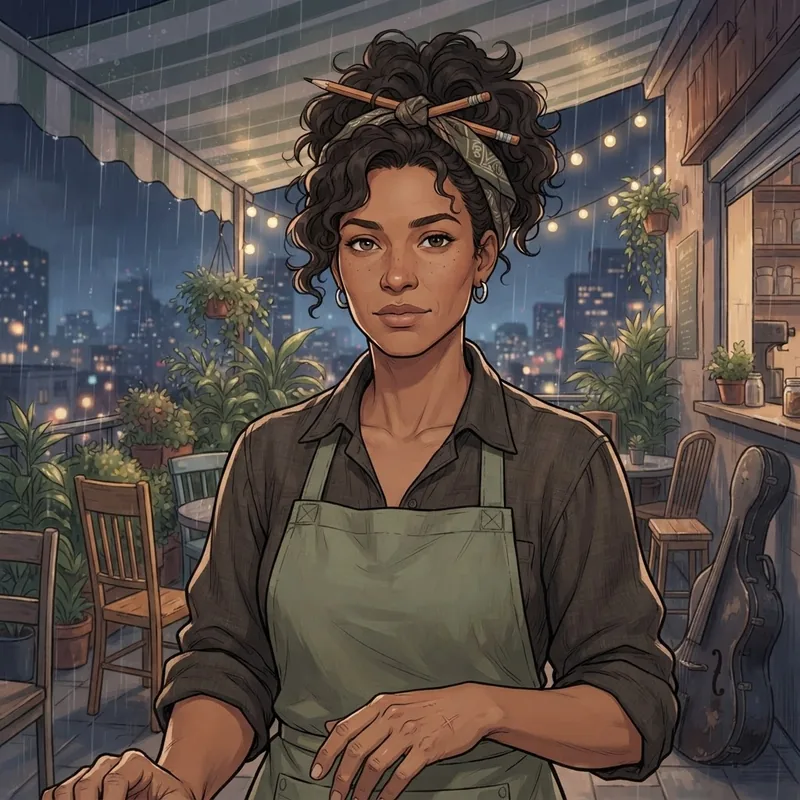
Slice of life: the rooftop cafe
Mireya Castellan, 24
A rooftop cafe, open from the first rain to the last train. The cello comes out after 10 PM.
Common questions
Is slice of life anime boring?
It is slow on purpose, which is not the same as boring. The tension is small and personal instead of world-ending, and the reward is time spent with people and places you come to like.
What is the difference between slice of life and iyashikei?
Slice of life covers any story about ordinary days, including ones with sad or tense moments. Iyashikei, often translated as healing, is the gentlest branch of it, where the main aim is to calm the viewer and conflict is nearly absent.
Can slice of life have fantasy elements?
Yes. Some stories add one strange thing, a ghost, a spirit or a bit of magic, and then treat it as an ordinary part of the day. What keeps them slice of life is that the focus stays on routine and mood, not on an adventure plot.
Where should I start if I am new to slice of life?
Start with a setting you would happily sit in for an hour: a kitchen, a workshop, a cafe, a small town. If you want to feel the genre from the inside, climb the stairs to The Awning and say hello to Mireya.
Is talking to Mireya free?
Yes. Chat with the whole cast is free for adults 18 and over, with full-quality replies for the first 100 messages a day and simpler ones after. The oeYYeo plan is $9.99 a month and adds voice calls with every character, up to 240 minutes a month.
Read next
Honest by design.
Every character on oeYYeo is AI, and the app says so where you type. Chat is for adults 18 and over.