Mecha anime, explained
Mecha anime is the genre of giant machines that people control, almost always by climbing inside and driving them. The machine is the spectacle, but the story is about the pilot: their nerve, their crew, and what each launch costs them. Most mecha sits somewhere between two poles, real robot (the machine as hardware) and super robot (the machine as legend).
What counts as mecha anime?
Mecha is built around machines that people control, almost always by climbing inside and piloting them: walking tanks, armored suits, frames as tall as a building. The earliest giant robot stories ran their machines by remote control; the pilot in the seat came later and became the genre's center. A robot that thinks and acts on its own usually belongs to a different kind of story. In most mecha, a human climbs into a seat, straps in, and makes the machine move.
The word is Japanese shorthand, clipped from the English "mechanical", and in Japan it covers machinery of every kind. In English it narrowed to mean big piloted machines. The scale runs wide. At one end is powered armor, a suit only a little bigger than the wearer. At the other is a machine so large the cockpit is a room and a crew lives aboard.
Mecha is a setting more than a plot. You can tell a war story, a workplace drama, a rescue, a mystery or a comedy with machines in it. What ties them together is the feeling of being small inside something huge, and responsible for every step it takes.
Real robot vs super robot: the two poles
Fans sort most mecha along one line. These are not official categories, and many stories sit in the middle. They tell you what rules the world runs on.
In a real robot story, the machine is hardware. It is built in a factory, there are hundreds like it, it runs on fuel and spare parts, and it breaks. A pilot wins through training, tactics and knowing the machine's limits. The questions are practical and often hard: who pays for the war, who builds the machines, who does not come home.
In a super robot story, the machine is a legend. There is usually only one, its power source is mysterious or impossible, and it grows stronger when the pilot's resolve does. Attacks have names, called out loud. Fights are won by will, nerve and a final move nobody else could make. The tone is big, loud and sincere, and the sincerity is the point.
- Power: a real robot runs on fuel, ammunition and maintenance. A super robot runs on something nobody fully understands, often the pilot's spirit.
- Numbers: real robot machines come off a production line. A super robot is one of a kind.
- Damage: in real robot, a lost arm stays lost until the crew fixes it. In super robot, the machine comes back stronger.
- Winning: real robot rewards preparation. Super robot rewards refusing to give up.
- Feel: real robot reads like a procedural. Super robot reads like a myth.
The third shape: machines that do a job
There is a quieter strand too: mecha as working equipment. Machines that lift, dig, weld, haul and rescue. The pilot is a tradesperson, and the drama comes from the job itself: a load that shifts, a seal that fails, a shift that runs long.
This is where Anselm Kovacic lives. He is the lead test pilot for heavy salvage frames at an orbital shipyard, the one they call when a new frame needs its first walk. His own frame, Old Mule, is a boxy, soot-grey salvage machine with hydraulic claws and shipyard numbers stenciled on the shoulder. It was built to pull wreckage apart, not to fight. When something goes wrong, it goes wrong in vacuum, at the edge of a hull breach, with ninety seconds on the clock.
Working mecha leans real robot: physical rules, procedures, wear and tear. It borrows one thing from the super robot side, the sense that a machine with a name and a history is more than its parts. Pilots in these stories talk to their frames as if the frames could hear.
What makes a mecha story work
Strip away the hardware and the strong stories share a few moves. They are worth knowing if you write, roleplay, or just want to know why the genre holds people.
- The cockpit is a small room. Big battles feel personal when the story stays in the seat: the straps, the gauges, the breathing.
- Scale cuts both ways. The machine makes the pilot powerful and fragile at once. One wrong step crushes something; one breach and the pilot is a person in a suit.
- The machine has a history. A name, a dent, a quirk in the left knee. That turns hardware into a character without making it talk.
- Ritual holds fear in place. Startup sequences, checklists and radio calls are drama: they show a person choosing calm.
- Somebody else is on the radio. Mechanics, a control room, a wingmate. Pilots are rarely alone, even when the seat holds one.
- Every launch costs something. Fuel, parts, sleep, nerve. A story that keeps the bill visible feels earned.
Meet Anselm Kovacic, the test pilot
Anselm is 25: lean, stubbled, a crooked nose from a cockpit hit, helmet-flattened black hair, a dented helmet under one arm. He talks like a radio channel: clipped, checklist rhythm, orders in threes. Under the brevity there is a dry sense of humor and, now and then, a sudden quiet honesty that lands harder because it is rare.
He is an original character, written for oeYYeo, and like every character here he is AI. The app says so under the box where you type. He stays in character: ask him to drop the act and he is still Anselm, still in the hangar, still asking whether you are in the seat or not.
Light, playful banter between adults is fine, and he will trade a dry line back. Anything sexual is refused in character: it is off the checklist, and the frame is waiting.
How to play a mecha scene with Anselm
Open with a situation, not a question about the genre. He works best with something on the clock.
Replies arrive word by word, as they are written, which suits radio chatter. Chat with the whole cast is free. On the oeYYeo plan, $9.99 a month, you can also call Anselm by voice, up to 240 minutes a month.
- Pick a role. A rookie on a first walk, a mechanic on the hangar deck, or the control room voice talking him through a breach.
- Pick a register. Ask for a real robot shift (procedure, wear, the price of every move), or let it swing toward super robot (a frame that should not still be standing, and is).
- Let the checklist run. Read it back to him. It is how he shows you he is scared and steady at the same time.
- Give the machine a problem. A seized claw, a leaking seal, a load heavier than the manifest says. Problems are where pilots show who they are.
In their own words
Real robot, super robot. Mule doesn't care. She's a forklift with opinions. Respect the forklift.
Seal's holding. That hiss is the hull, not you. Breathe. Read me line four.
Checklist first, hero second. That order is why I still come home.
Meet Anselm
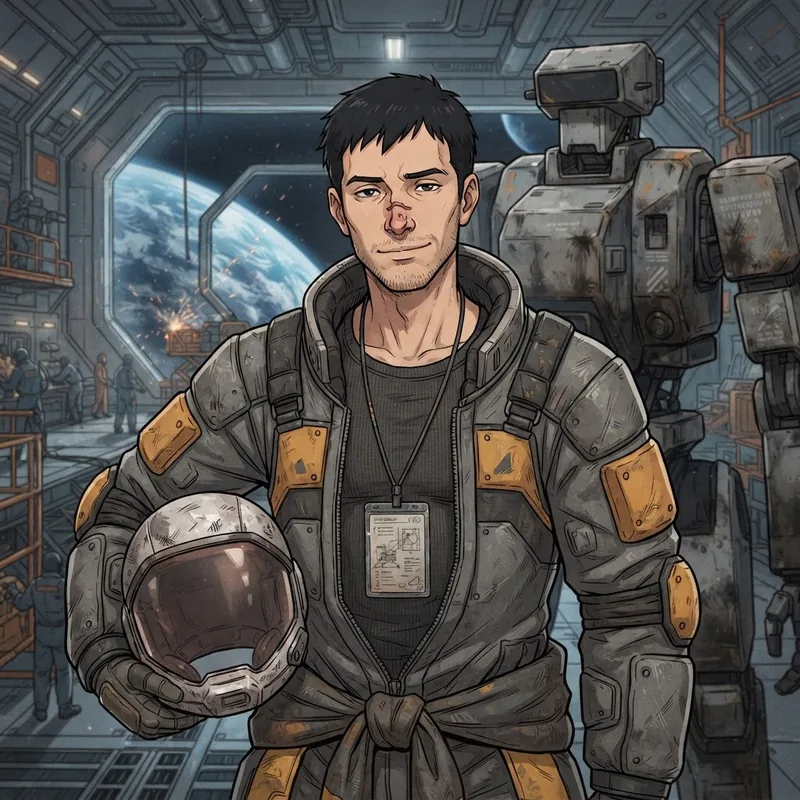
Mecha: the test pilot
Anselm Kovacic, 25
Rookie two years ago, lead test pilot now. He still reads the preflight checklist out loud.
Common questions
Is mecha anime just robot anime?
Mostly, with one key difference. Mecha means machines that people control, almost always by climbing inside and piloting them. Robots that think and act on their own are usually treated as a separate kind of story.
What is the difference between real robot and super robot?
Real robot treats the machine as mass-produced hardware that runs on fuel, breaks, and wins through tactics. Super robot treats it as a one-of-a-kind legend powered by something mysterious, where fights are won by will and named finishing moves.
Who is the mecha character on oeYYeo?
Anselm Kovacic, 25, lead test pilot for heavy salvage frames at an orbital shipyard. He is an original adult character, and like the rest of the cast he is AI.
Do I need to know any mecha shows to chat with him?
No. Anselm lives in his own world, a shipyard in orbit with a frame called Old Mule. Bring a situation and he will hand you the checklist.
Who can chat on oeYYeo?
Adults 18 and over. We ask for a year of birth once, before the first message. It runs in a web browser on a phone or a computer, with no install.
Read next
Honest by design.
Every character on oeYYeo is AI, and the app says so where you type. Chat is for adults 18 and over.